How Do You Pick the Best Pickleball Paddle?
Choosing the right pickleball paddle involves matching key paddle features with a player’s skill level and playing style. The goal is to strike the perfect balance between core material and thickness, surface material, weight, and grip size to suit individual needs.
While it would be nice to claim there’s a single paddle that works for everyone, the reality is far more nuanced.
For example, a player seeking more power to compensate for a lack of control would need a paddle with entirely different materials and construction than someone prioritizing precision and reduced pop.
Though finding the ideal paddle may seem like a daunting task, this guide will show you why it’s worth the effort. By breaking down the process into five simple components, we’ll make it easy to understand and remember.
By the time you finish reading, you’ll know exactly which pickleball paddle suits your game and what adjustments you can make to bring out your best performance on the court.
5 Key Elements for Choosing the Best Pickleball Paddle
In this section, we’ll explore the five most important factors to consider when purchasing a pickleball paddle: core material, core thickness, surface material, paddle weight, and grip size. Let’s dive in!

1. Pickleball Paddle Core Materials
It’s widely known that choosing the right pickleball paddle is crucial to success on the court. However, one often overlooked factor is selecting the right core material. Although you can’t see the core while shopping or playing, it plays a significant role in the overall performance of the paddle.
What is a Pickleball Paddle Core?
The core is the internal structure of the paddle, often made of honeycomb-shaped material that sits between the two faces of the paddle. This core can be constructed from various materials, each influencing the paddle’s performance differently.
What Materials Are Used for the Best Pickleball Paddle Cores?
There are several materials used for paddle cores, but Nomex and polymer are the most common today. Each offers a distinct feel, impacting the paddle’s power, control, and overall playability.
Nomex Core Pickleball Paddles – Power
Nomex is a dense, lightweight polyamide material known for its strength and durability. It is used in various industries, including military and aviation, due to its flame-resistant properties. The use of Nomex in pickleball paddles dates back to the 1980s when a Boeing engineer and avid pickleball player, Arlen Paranto, created the first composite paddle with a Nomex core.
Nomex cores tend to have smaller, more numerous honeycomb shapes, which increase surface area and rigidity, ultimately producing more power on each hit.
Polymer Core Pickleball Paddles – Power and Control
Polymer, or polypropylene, is the most popular core material in today’s paddles. Known for its durability and flexibility, polymer offers a great balance of power and control, making it an ideal choice for new players.
Polymer cores can also come in hybrid constructions, such as Paddletek’s Tempest series, which combines carbon fiber with polymer to enhance performance.
Why Core Material Matters
The core material is the unseen powerhouse of your paddle. Different materials provide various benefits, such as increased power, better accuracy, enhanced control, or vibration reduction. Choosing the right core material for your playing style is key to elevating your performance on the court.If you’re purchasing your first paddle, especially from a site like Amazon, take a close look at the core material. Budget paddles may feature wood or basic plastic cores, which offer less performance than advanced materials like polymer or Nomex.
Understanding the core material will help you choose a paddle that best fits your needs, ensuring a better playing experience and improved game results.
2. Pickleball Paddle Core Thickness
Once again, the core takes center stage in paddle performance—this time, it’s all about its thickness, not the material. The depth of the core inside the paddle has a significant impact on how the paddle plays.
What is Core Thickness in Pickleball Paddles?
Core thickness refers to the distance between the inner edges of the paddle’s core. This measurement is usually given in millimeters, with thicker cores typically around 16mm, and thinner ones closer to 11mm. The thickness can vary across different paddles.Core thickness may also be listed in inches. To give you a reference, a 0.5-inch thickness is roughly equal to 13mm, which is considered medium. Adjusting by 1/16 inch up or down will get you closer to thin or thick core paddles.
Why Core Thickness Matters
The thickness of the core affects both control and power. A thicker core tends to offer better control, as it softens the ball’s impact when it hits the paddle. In contrast, a thinner core will generate more power by creating a firmer response.The key trade-off here is that a thicker core gives you more control but less power, while a thinner core provides more power but less control. This balance between control and power is one of the common considerations when selecting the best paddle for your style of play. The right core thickness can help you find the ideal paddle that enhances your game.
Should You Choose a Thicker or Thinner Core?
Choosing between a thick or thin core depends largely on your experience level. For beginners, a medium to thick core is generally recommended, as it provides more control and helps soften the impact. More experienced players may prefer thinner cores if they’re looking to generate more power, as they’re better able to manage control without losing too much touch.Ultimately, the right core thickness comes down to your personal playing style and what aspect of your game you want to enhance most.
3.Pickleball Paddle Surface Materials
When it comes to the surface material of a pickleball paddle, you may be surprised by the variety of options available—from wood to hybrid composites. If it can be attached to a paddle, it likely exists. However, today, the most common surface materials you'll encounter are fiberglass, carbon fiber, and graphite. Here’s what you need to know about each.
Fiberglass Pickleball Paddles – Power Material
Fiberglass is the heaviest of the three materials, but it’s also the most flexible. When the ball strikes a fiberglass paddle, the surface gives slightly, absorbing the impact before releasing the energy as the ball springs off the paddle face. This “spring-like” response, combined with the extra weight, allows fiberglass paddles to generate more power in your shots.
Graphite Pickleball Paddles – Finesse Material
Graphite is lightweight yet extremely strong, making it a great choice for precision sports like pickleball. When the ball hits a graphite paddle, the material helps distribute the impact evenly across the entire paddle face, creating a larger sweet spot. This results in more consistent ball control and a finer touch. However, this material tends to sacrifice some of the raw power that fiberglass provides.
Carbon Fiber Pickleball Paddles – Balanced Power and Finesse
Carbon fiber, often used in high-performance paddles like those in JiangoSport’s series, is lighter and stronger than graphite. As a subtype of graphite, carbon fiber provides an excellent balance between power and finesse. It combines the durability and flexibility of fiberglass with the control and responsiveness of graphite, making it a popular choice for versatile paddles that aim to provide the best of both worlds.
Graphite vs. Fiberglass Paddles: What’s the Difference?
This comparison is a bit like comparing apples to oranges. Fiberglass is the go-to material if you're looking for power in your shots, as it delivers a more elastic response. Graphite, on the other hand, is better suited for players who prioritize finesse and a smoother touch. Each material influences how the ball reacts when it hits the paddle, directly affecting your control and shot power.
Choosing the right surface material is crucial because it significantly impacts both your control and power. Whether you prefer a paddle that emphasizes power, touch, or a balance of both, selecting the right surface material is key to optimizing your performance on the court.
 4.Pickleball Paddle Grip Size
When you go to purchase a pickleball paddle, one thing you'll want to know with certainty is the grip size that best suits your hands. And we're not referencing the style of grip you use, instead, this is all about the dimensions of your grip.
What Is the Difference between a Handle and a Grip?
Grips and handles are often used interchangeably, but when you add length and circumference to the equation, they mean entirely different things. A paddle's handle length measures the grip from the jewel to the neck of the paddle, while its grip circumference measures the distance to wrap around the handle.
What Are the Grip Size Options?
Grip sizes come in quite a few options, but the vast majority of them will fall between 3.875" and 4.375", separated by increments of 1/16". Most players will purchase a pickleball paddle around the 4 1/8" to 4 3/8" circumference, where 4 1/8" is a safety circumference that can be taped to add volume.
Finding the Right Grip Size
So if you're on the market to find the right grip size, get out there and hold and play with paddles that have different grips.
Why Grip Size Matters
Grip size is an important factor when selecting a pickleball paddle because it affects the way you handle and control your shots.
Too small and you'll be fumbling with your hold more than you'd like - fatigue and poor control follow suit. Too big and you won't be able to get the right grip, losing control of your shots in more ways than one.
And that's all without mentioning general discomfort. You can't play your best when you're thinking about your hand and how it feels; picking the right size is essential for top performance while also avoiding any uncomfortable blisters!
5. Pickleball Paddle Weight
Paddle weight is the final essential choice you'll need to make when buying a pickleball paddle. It's a big one too, which is one of the reasons it's earned an entire article dedicated to picking the right weight for a pickleball paddle. But to summarize the key points from that article, here's what you'll need to know.
What Are the Typical Paddle Weights in Pickleball?
Pickleball paddle weights are classified into three classes, midweight (between 7.3 and 8.5 ounces), lightweight (7.3 ounces and lighter), and heavy (8.5 ounces and up). Midweight paddles are suited for beginners, while lighter paddles assist with control, and heavier paddles boost power.
Everything contributes here, from edge guard and decorative jewels to the core materials, it all has an impact on weight, and by turn, swing speed.
Why Pick a Light Paddle?
Going lightweight with your pickleball paddle can be a great way to boost control and reaction times. This is great when you're near the net. So if you're looking for gentler dinks and don't care so much about power, you may want to look into a lighter paddle.
There are some downsides to this though, outside of power, namely the health of your arm.
With a lighter paddle, it absorbs less energy every time it contacts the ball, instead, your arm will start to pick up the heavy lifting. If you have a history of tennis and golf elbow, this probably won't be the best weight for you.
Also, some players find they have to extend their swings to get enough power, which is a game of compensating for weight. This can also be detrimental to a healthy arm.
Why Pick a Midweight Paddle?
If you're new to pickleball, midweight is a great class to start with. A midweight paddle toes the line of power and control, so it's ideally suited for all skill levels and shots. Whether you're looking for a soft dink or a power serve, this weight class should suffice.
Why Pick a Heavy Paddle?
If you need more power behind your shots, this is when you would want to pick a heavier paddle. But this comes with a huge disclaimer; heavy paddles are rarely good options for new players since they require a higher degree of control and placement to wield properly, and beginners rarely possess those skills.
Plus, if you have any sort of arm health problems, this will certainly exacerbate those issues since you'll experience arm fatigue more rapidly. It's not all doom and gloom though, because players who just want some extra oomph on their shots will love the weight.
And tennis players making the switch to pickleball will appreciate the feeling a heavy paddle has compared to a tennis racquet.
Not so much a direct comparison of weight, but more so the motion and swing of contacting a pickleball with a heavier paddle - it will feel more akin to tennis backswings.
In general, the best pickleball paddles for beginners will be the midweight classification, whereas the best pickleball paddles for experienced players could be any weight, as they more likely know the right weight to support their game.
Picking the Best Pickleball Paddle is a Balancing Act
By now, it’s clear that there’s no one-size-fits-all solution when it comes to choosing the best pickleball paddle. Every decision you make involves balancing two opposing factors, and this applies to all five key elements we’ve discussed. For instance, you might opt for a surface material that boosts power, but choose a weight that enhances control at the cost of some of that power.
Choosing the best paddle isn’t about perfecting one element; it’s about striking the right balance across the entire paddle, taking into account all its key features.
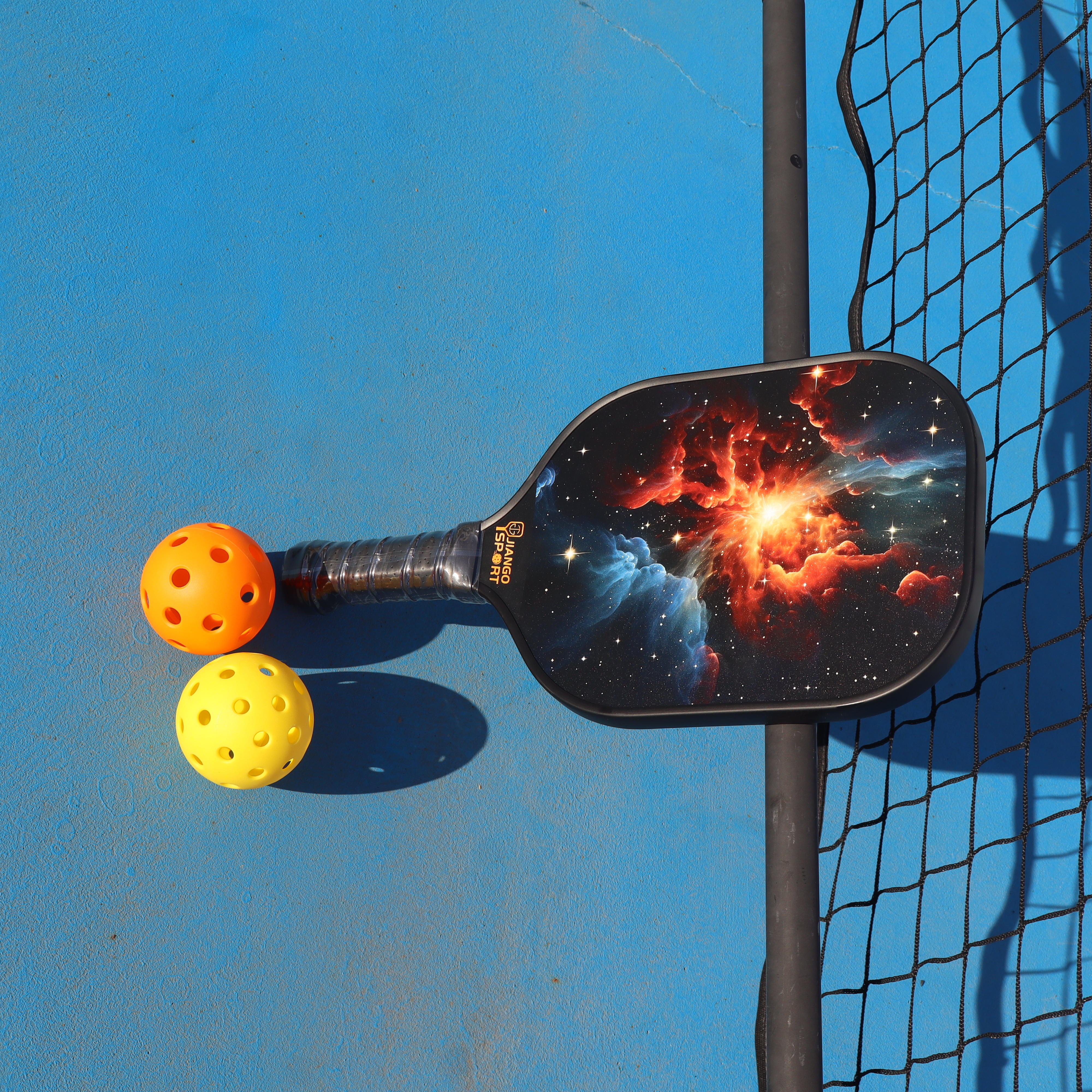
At the end of the day, JiangoSport's classic fiberglass paddle is an excellent choice for beginners. With its balanced thickness and comfortable grip circumference, this paddle is designed to provide an optimal playing experience for newcomers to the sport. Its user-friendly features make it a top pick for those just starting out, offering a perfect combination of power and control to help players develop their skills.